Blepharoplasty is a surgical procedure aimed at rejuvenating the eyes by correcting excess skin, fat, or bags that naturally appear over time in the eyelids.
It is a safe and highly effective procedure, which can be performed on its own or combined with other facial surgeries for a more complete rejuvenation.
The result is a brighter, fresher, and natural appearance, while always preserving each patient’s unique expression.
Blepharoplasty is usually carried out under local anesthesia alone or associated with mild sedation, allowing for a faster and more comfortable recovery. The procedure generally lasts 1 to 2 hours, depending on whether the upper eyelids, lower eyelids, or both are being treated.
The sutures are fine and discreet, and most patients can return to their daily activities within a few days.
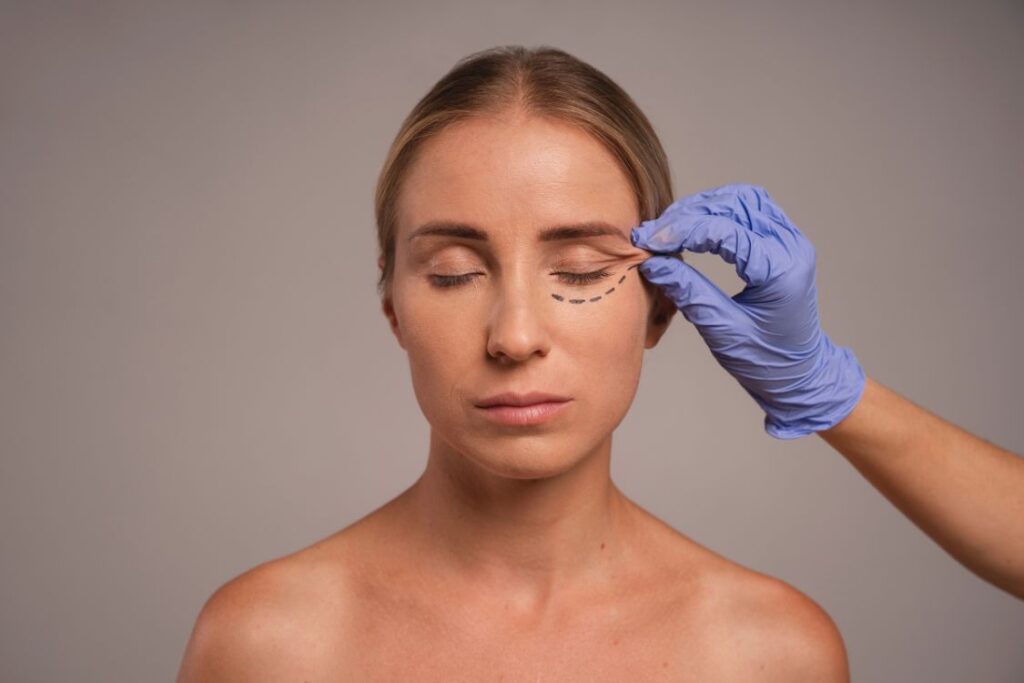
The results of blepharoplasty are noticeable within the first few days, although the final appearance becomes progressively clearer as swelling subsides.
Blepharoplasty provides long-lasting results, often maintained for many years. The goal is always to achieve a natural and expressive look, without creating an artificial change in the patient’s appearance.
There is no exact age. It is generally considered from the age of 35–40, when excess skin or bags appear, although it may be performed earlier if there is a genetic predisposition.
Incisions are placed in the natural eyelid creases for upper blepharoplasty or just below the eyelashes/inside the eyelid for lower blepharoplasty, making them virtually unnoticeable once healed.
Most patients return to daily activities within 7–10 days. Swelling and bruising resolve within a few weeks, and the final result is visible in 1–3 months.
It is generally not painful. Patients usually experience mild tightness or discomfort that can be easily managed with standard analgesics.
The results are long-lasting, often maintained for life, although the natural aging process continues.

